Find a world.
Each familiar kiosk becomes a marker in an unfamiliar spatial system. The next world may be close — or hundreds of yards away.
An experience that brings our solar system into perspective through a one-mile interactive journey.
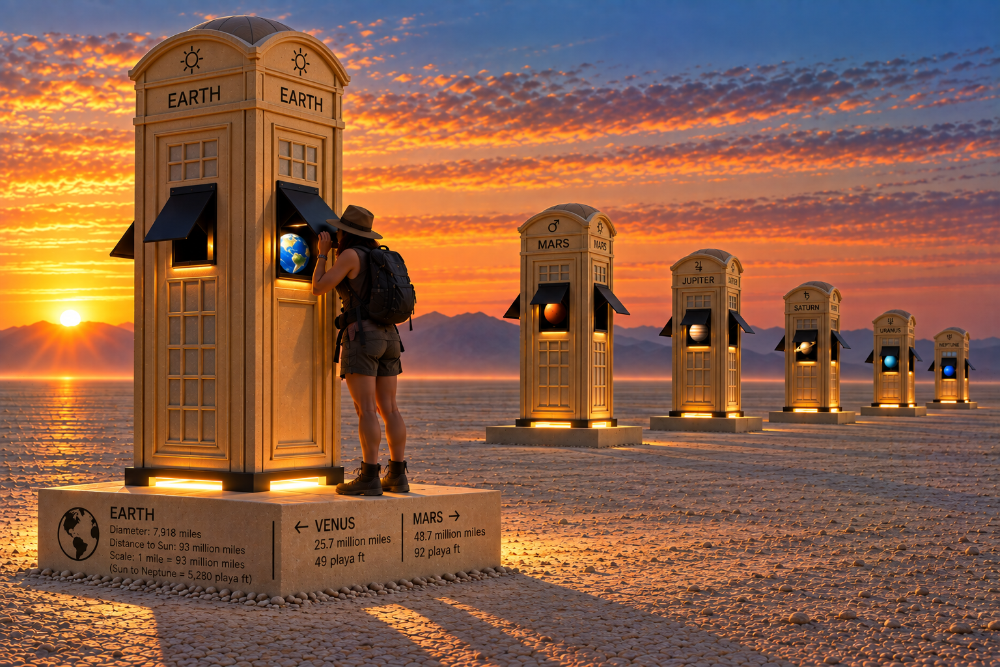
Perspective changes when distance becomes physical.
Nine desert-colored kiosks based on the iconic British telephone box are distributed across exactly one mile. Each box is sealed, dark inside, with a small viewing window on each face.
Look through a viewing window and a luminous Sun or planet appears against complete black: large, familiar and immediately recognizable. It turns in the darkness, then recedes until it reaches its true diameter at exactly the same scale as the distances separating the worlds outside.
The visitor is not simply walking past markers. They are moving through one coherent model in which size and distance obey the same rule. The further you travel, the more the distances begin to dominate the worlds themselves.
This is the key idea of the work. Each world begins at a familiar, legible size, then visibly collapses to its true diameter within the one-mile model. The final image is not a symbolic stand-in: it is reduced using exactly the same scale that places Neptune one mile from the Sun. At this scale, the Sun is only about 19.6 inches across, Earth is about 3/16", and even Jupiter is only about 2 inches.
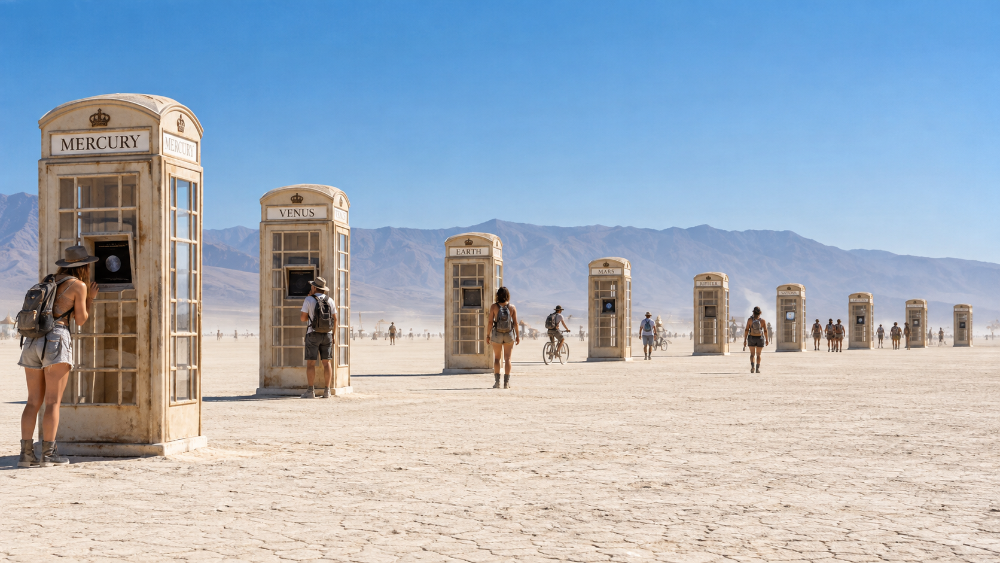
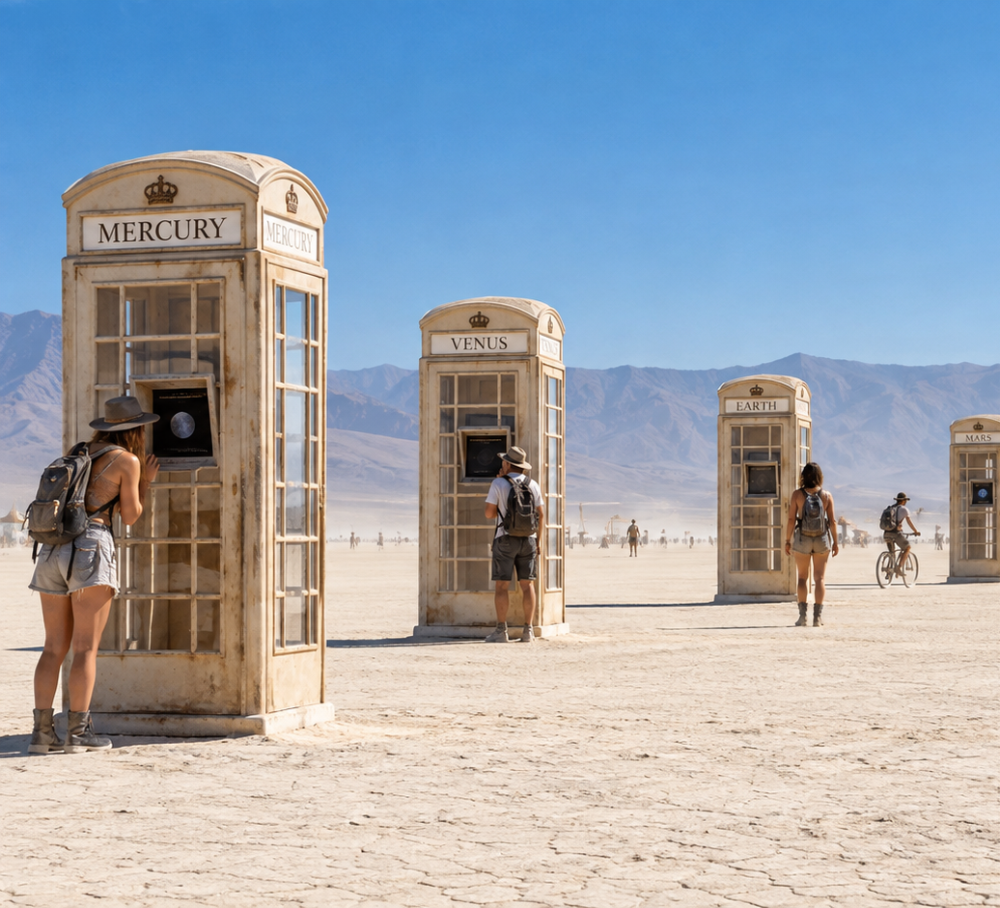
Each familiar kiosk becomes a marker in an unfamiliar spatial system. The next world may be close — or hundreds of yards away.
Through the small viewing window, a completely dark chamber isolates a familiar world from everything around it.
The world turns, then shrinks until it reaches its true diameter at the same scale as the one-mile journey outside. Earth becomes only about 3/16" across.
Move to the next world. The objects become tiny; the emptiness becomes enormous. Distance, proportion and perspective shift together.
At every station the same sequence plays. A vivid world first appears large enough to recognize, then recedes through blackness until it reaches its scientifically scaled diameter. The transformation is the moment the scale becomes felt rather than merely understood.
Total viewing sequence: approximately 10 seconds. This preview loops automatically to show the transformation from familiar image to scientifically scaled endpoint.
At the proposed scale, Neptune sits exactly one mile from the Sun. The same scaling rule determines the final displayed diameter of the Sun and every planet. The inner planets cluster surprisingly close to the start, while the outer solar system opens into long stretches of apparent emptiness.
Scale basis: average orbital distances from the Sun, rounded for visitor-facing signage. The physical layout is normalized so Sun → Neptune equals exactly 5,280 ft (1 mile).
The visual language deliberately begins with something recognizable: the classic British telephone box. Its function is removed and its windows are closed. What remains is an object associated with communication — now asking the visitor to look rather than speak. The boxes themselves are not the scale model. The distances outside and the final rendered size of each celestial body are.
These are the values to use across fabrication, renderings and the final installation. Astronomical figures are rounded differences between average orbital distances; playa distances are scaled to a one-mile Sun-to-Neptune system.
The proposed world premiere is Black Rock City 2027. Few environments allow one artwork to occupy enough open land for astronomical distance to become physically legible. The horizon, darkness, weather, movement and the effort of reaching the next station all become part of the composition.
The piece is conceived to reward both accidental discovery and deliberate completion: one phone box can stand alone as a strange encounter; walking the full system reveals the work’s real subject.
For exhibition, collaboration, fabrication or project enquiries, send a note here. The form will be handled by the site when deployed on Netlify.